Starting a fashion brand is an exhilarating journey. You have the vision, the designs, and the target audience in mind. However, many new entrepreneurs hit a significant speed bump when they make their first contact with a factory: the Minimum Order Quantity (MOQ).
For a startup brand or a founder engaging in Direct-to-Consumer (DTC) sales, hearing that a factory requires 500 or 1,000 units per style can be discouraging. It creates a barrier to entry that feels financial and logistical. Why are the numbers so high? How can a small business afford that upfront cost?
Understanding minimum order quantities in apparel manufacturing is crucial for your business’s survival. MOQs are not just arbitrary numbers; they directly influence your production costs, your inventory risk, and your ability to scale. While MOQs vary significantly depending on the manufacturing model you choose, navigating them correctly is the difference between a successful launch and sitting on boxes of unsold inventory.
In this guide, we will demystify MOQs, explain the economics behind them, and show you how to find the right partners to grow your brand. And how Cord Apparel is your right choice as a manufacturing partner.
What Is a Minimum Order Quantity (MOQ)?
At its simplest level, a Minimum Order Quantity (MOQ) is the lowest number of units a manufacturer is willing to produce for a single order. If a factory has an MOQ of 300 units, you cannot order 299. They will simply decline the contract.
However, for fashion entrepreneurs, the definition gets a little more complex. In the world of apparel manufacturing MOQ, the “order” isn’t always just the total number of garments. MOQs are often broken down into a hierarchy that you must understand:
- MOQ Per Order: The total number of garments required to open a production run.
- MOQ Per Style: The minimum number of units required for a specific design (e.g., a specific T-shirt cut).
- MOQ Per Color: The minimum number of units required per colorway (e.g., 100 black, 100 white).
- MOQ Per Size: While less common, some factories require a minimum number of units per size, though usually, this is an aggregate of the size run (e.g., S-XL).
Why is this standard? Imagine a bakery. If you ask a baker to mix dough, heat the massive industrial oven, and clean the equipment just to bake one single cookie, the cost of that cookie would be astronomical. The same logic applies to clothing. Minimum order quantity clothing rules exist to ensure that the time, energy, and resources spent setting up the production line are worth the factory’s effort.
Why Do Clothing Manufacturers Have MOQs?
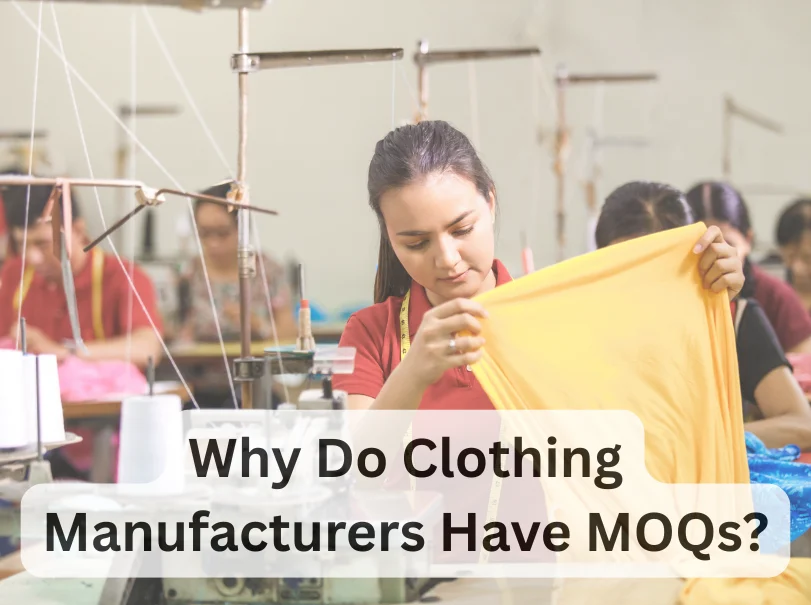
To negotiate effectively, you need to understand the factory’s perspective. Manufacturers aren’t trying to be difficult; they are trying to remain profitable.
There are four main drivers behind minimum order quantities in apparel manufacturing:
1. Fabric Sourcing Minimums
This is often the biggest culprit. Garment factories don’t usually make the fabric; they buy it from textile mills. These mills have their own MOQs. If a factory must buy a roll of fabric that yields 500 shirts, but you only want 50, the factory is left with wasted material they paid for. Custom-dyed fabrics usually have much higher MOQs than stock fabrics.
2. Labor and Machine Setup Costs
Setting up an assembly line takes time. Machines must be calibrated for specific fabrics, threads must be changed, and patterns must be digitized and laid out. This “setup time” costs the same whether you produce 10 units or 10,000 units. High MOQs allow the factory to spread this fixed setup cost over many units, keeping the price per shirt reasonable.
3. Production Efficiency
Apparel manufacturing relies on rhythm and flow. When sewing operators work on the same style for three days straight, they get faster and make fewer mistakes. If they must stop every hour to switch to a new style (which happens with low MOQs), their efficiency plummets, and the factory loses money.
4. Profit Margins
Factories operate on very slim margins. The administrative work—emails, sourcing, invoicing, and shipping—takes the same amount of effort for a small order as it does for a large one. Without an apparel manufacturing MOQ in place, the administrative cost alone would eat up the profit on small orders.
We, at Cord Apparel, provide low MOQs so that even small private label brands can partner with us.
Typical MOQ Ranges in Apparel Manufacturing
It is difficult to give an exact number because every factory is different, but knowing the general ranges helps you plan your budget. The clothing manufacturer MOQ will fluctuate heavily based on the method of production.
Private Label MOQs
Range: Low to Mid (e.g., 50–300 units) [Private Label Clothing] involves taking an existing blank garment (like a generic hoodie) and adding your branding to it. Because the garment is already made, the MOQs are much lower. This is often the best entry point for new brands.
Cut and Sew Custom Manufacturing MOQs
Range: Mid to High (e.g., 300–5,000+ units) Cut and sew MOQ requirements are higher because the factory is building your garment from scratch—rolling out fabric, cutting the patterns, and sewing it together. This requires full production line setup, hence higher commitment. Cord Apparel also provides cut and sew manufacturing services.
Screen Printing vs. Embroidery
- Screen Printing: Often has MOQs around 24–50 units because burning screens and mixing ink takes time.
- Digital Printing (DTG): Can often be done with an MOQ of 1, but the cost per unit is much higher.
USA vs. Overseas Differences
Domestic (USA) manufacturers offer lower MOQs (often 50–300 units) compared to overseas manufacturers (often 1,000+ units). We will dive deeper into this comparison later.
Factors That Affect MOQ in Apparel Manufacturing
If you want to lower your apparel production minimums, you need to understand the variables that drive the numbers up.
Fabric Type and Sourcing
Using “Stock Fabric” (fabric the factory already has or can easily buy) dramatically lowers your MOQ. If you demand a custom bamboo-spandex blend dyed to a specific Pantone color, the mill will force a high MOQ on the factory, which the factory will then force on you.
Number of Colors and Sizes
The more variables you add, the higher your total order usually needs to be.
- Example A: 1 Style, 1 Color = Lower MOQ.
- Example B: 1 Style, 4 Colors = Higher MOQ, because the factory must switch threads and fabrics four times.
Garment Complexity
A basic T-shirt is fast to make. A waterproof jacket with magnetic closures, six pockets, and taped seams is slow. Custom apparel MOQ for complex items is higher because the factory needs a longer run to recover the high cost of training their staff on how to assemble your complicated design.
Embellishments
If your design requires screen printing, embroidery, and a custom woven label, you are involving three different departments or subcontractors. Each step has its own minimums, which can aggregate into a higher total MOQ.
Low MOQ vs High MOQ Manufacturing: What’s the Trade-Off?
As a startup, your instinct is likely to search for low MOQ clothing manufacturers. While this reduces risk, it comes with trade-offs. It is essential to balance the unit price against your cash flow.
| Feature | Low MOQ Manufacturing | High MOQ Manufacturing |
|---|---|---|
| Cost Per Unit | Higher. You pay a premium for flexibility. | Lower. Economies of scale kick in. |
| Inventory Risk | Low. You are less likely to have unsold stock. | High. If the style flops, you lose more money. |
| Speed to Market | Faster. Smaller batches are quicker to produce. | Slower. Large runs take weeks or months. |
| Customization | Limited. Often relies on stock fabrics. | Unlimited. Custom dyes and fabrics are possible. |
| Ideal For | Startups, Testing Markets, Limited Drops. | Scaling Brands, Core Collections, Wholesalers. |
For many, paying a higher cost per unit for small batch clothing manufacturing is worth it to avoid tying up $20,000 in inventory that might not sell.
How Startups Can Work with MOQ Requirements
You don’t always have to accept the first number a factory gives you. However, rather than just asking for a lower number, you should strategize to make your order more attractive to the manufacturer.
1. Start With Fewer Styles
Do not launch with 10 different designs. Launch with 3 strong designs. This allows you to put your entire budget into meeting the MOQs for those three items, rather than spreading your cash too thin and missing the minimums for everything.
If you want to make a hoodie, a jogger, and a t-shirt, try to design them so the hoodie and jogger use the exact same fabric and color. This consolidates your fabric consumption, helping you meet the MOQ in garment manufacturing related to the textile mill.
3. Choose Private Label Options
If you are just starting, consider [Private Label Clothing]. You can buy high-quality blanks and customize them with print, embroidery, and labels. This allows you to bypass the high cut and sew MOQ until you have a proven customer base.
4. Launch Small Test Runs
Look for manufacturers who offer sample runs or “salesman samples.” You will pay a premium (sometimes 2x or 3x the production price), but it allows you to evaluate the product on the market before making a full order.
USA vs Overseas MOQs Explained
Geography plays a massive role in minimum order quantities in apparel manufacturing.
Manufacturing in the USA
US-based manufacturers typically cater to the premium, boutique, and startup markets.
- MOQ: Generally Lower (50–300 units).
- Cost: Higher labor costs reflect the unit price.
- Advantage: Easier communication, faster shipping, and higher quality control. Great for responsive fashion and quick restocking. Check out our guide on [Clothing Manufacturing USA vs Overseas] for a deep dive.
Manufacturing Overseas (Asia)
Factories in China, Vietnam, and Bangladesh work on volume. Their business model relies on massive throughput.
- MOQ: Generally Higher (1,000–5,000+ units).
- Cost: Significantly lower unit cost.
- Advantage: Best for basic items where margin is everything, provided you have the capital to fund large orders and the warehousing to store them.
Can You Negotiate MOQ With Clothing Manufacturers?
Yes, but it requires a partnership mindset. You cannot simply demand a lower number. You must offer something in return.
- Pay a Surcharge: Tell the factory, “I know your MOQ is 300, but I can only do 150. I am willing to pay 20% more per unit to make this work.” Many factories will accept this as it covers their setup costs.
- Commitment to Future Orders: If you can show a solid business plan or marketing strategy, some factories may lower the initial apparel manufacturing MOQ in hopes of securing your future large-volume business.
- Extend Lead Times: Sometimes, if you tell a factory they can produce your order “whenever they have downtime” over the next few months, they may accept a smaller order to fill gaps in their schedule.
How Cord Apparel Supports Low MOQ Apparel Manufacturing
At Cord Apparel, we understand the specific challenges DTC founders and startups face. We know that high minimums can kill a great idea before it ever hits the shelf.
That is why we position ourselves as a growth partner, not just a factory.
- Startup-Friendly MOQs: We offer competitive low MOQs to help you get your foot in the door without breaking the bank.
- Flexible Production: If you need [Cut & Sew Manufacturing] for a fully custom design or simple blanks for a streetwear, drop, we can adapt to your needs.
- Hybrid Approach: We have networks in both the USA and overseas. We can help you start with low MOQ clothing manufacturers domestically for your launch and transition you to overseas production as you scale up.
- Tech Pack Services: We help you professionalize your design process with our [Tech Pack Services], reducing errors and making production smoother.
We believe in small batch clothing manufacturing as a valid strategy for sustainable growth.
Final Thoughts on MOQ in Apparel Manufacturing
Minimum order quantities in apparel manufacturing are often viewed as the enemy of the startup, but they are just a reality of industrial economics. They force you to plan better, narrow your focus, and validate your designs.
Instead of looking for the factory with the lowest possible numbers (which often leads to poor quality), look for a factory that communicates well and offers a roadmap for growth. MOQs are not a permanent barrier; they are a hurdle you clear with smart planning and the right partner.
Don’t let production minimums stifle your creativity. If you are ready to navigate the world of manufacturing with a partner who understands your constraints, we are here to help.

Leave a Reply