Deciding where to produce your garments is one of the first and most critical choices you will make as a fashion brand founder. It isn’t just a logistical detail; it defines your margins, your quality standards, and your brand story.
Many startups become entangled in the debate over clothing manufacturing in the USA versus overseas. There is a common myth that overseas products are always cheaper than domestic products, which are of higher quality. The reality is more nuanced. Your choice impacts how fast you can launch, how you manage quality control, and how your customers perceive your label.
In this guide, we break down the real pros, cons, and costs of domestic vs. overseas clothing manufacturers to help you decide which path, or a hybrid of both, is right for your business. We will also investigate how Cord Apparel fits best as a trusted clothing manufacturer.
What Does “USA Clothing Manufacturing” Mean?
Before comparing, let’s define exactly what we are talking about. When we discuss domestic manufacturing, we usually refer to facilities within the United States that manage the physical assembly of garments. Let’s see, how do we define it?
This typically falls into two categories:
- Cut and Sew Manufacturing: The factory takes your fabric and patterns, cuts the material, and sews the final product. This offers total customization.
- Private Label: The manufacturer provides pre-made “blank” clothing, and you add your branding (labels, prints, embroidery).
Note: To legally label your product “Made in USA,” you must adhere to strict Federal Trade Commission (FTC) guidelines. The product must be “all or virtually all” made in the U.S. This is a powerful selling point for premium brands, denim companies, and luxury streetwear.
What Is Overseas Clothing Manufacturing?
Overseas manufacturing refers to outsourcing production to countries with established textile infrastructures. While “Made in China” is the most common association, major fashion hubs also include Vietnam, Bangladesh, India, Portugal, and Peru.
Overseas manufacturers are the engine of the global fashion industry. They are typically set up for large-scale operations. While US factories often work with startups on small batches, overseas facilities are designed to produce thousands of units per style. This is the standard route for brands that rely on high volume to achieve low prices.
Why “Made in USA” is a Power Move for Your Apparel Brand (Pros)
Choosing a domestic partner isn’t about patriotism; it’s a strategic decision that can stabilize your business model.
Here is why keeping your production is often the smartest play for your bottom line:
1. Precision and Quality Control
When your manufacturer is a drive away, “quality assurance” becomes more than just a phrase in an email. You can conduct in-person factory visits and spot-check production runs in real time. Furthermore, U.S. manufacturing operates under strict labor and safety regulations, which naturally translates to a higher, more consistent standard of craftsmanship. You aren’t just buying a garment; you’re buying peace of mind.
2. Speed to Market (The “Amazon Effect”)
In an industry that is driven by trends, timing is everything. While overseas shipments can spend weeks on a container ship, domestic goods can move from the sewing floor to your warehouse in a matter of days. This agility allows you to restock bestsellers quickly and react to market shifts before the trend dies.
3. Seamless Communication
Nothing kills a production timeline faster than a 12-hour time difference and a language barrier. Working with U.S. shops means you’re operating in the same (or similar) time zones. If a design tweak is needed or a fabric issue arises, you can resolve it with a quick phone call during business hours, rather than waiting through a 24-hour email cycle.
4. Lean Inventory with Lower MOQs
One of the biggest hurdles for startups is the dreaded Minimum Order Quantity (MOQ). Overseas factories often require thousands of units to make a run worthwhile. Conversely, many U.S. boutiques and mid-sized factories specialize in “small-batch” production. Being able to order 50 to 100 pieces allows you to evaluate the market, validate your designs, and scale without drowning in unsold inventory.
5. The “Made in USA” Marketing Edge
Ethical consumerism is no longer a niche—it’s the standard. Today’s shoppers are increasingly willing to pay a premium for transparency and fair labor practices. Featuring a “Made in USA” tag provides an immediate narrative of quality and social responsibility, giving your brand a competitive edge in a crowded marketplace.
The Other Side of the Coin: Challenges of U.S. Manufacturing
Here is what you need to prepare for if you decide to keep your production in the USA:
1. Higher Cost of Goods Sold (COGS)
The most obvious hurdle is the price tag. U.S. labor costs are significantly higher than those in major garment hubs like Vietnam, Bangladesh, or China. Because you are paying for fair wages and regulated working conditions, your per-unit cost will be higher. This usually means you’ll need to position your brand in the premium or luxury price bracket to maintain healthy profit margins.
2. A Diminishing Labor Pool
Decades of outsourcing have led to a “skills gap” in the American textile industry. Finding highly specialized labor can be difficult. While the industry is seeing a resurgence, the sheer scale of the workforce doesn’t match that of overseas manufacturing hubs.
3. Sourcing Raw Materials
Even if your clothes are sewn in the USA, the fabric often isn’t. The U.S. has a limited number of textile mills compared to Asia or Europe. You may find yourself in a situation where you are importing fabric from Italy or Japan, only to have it cut and sewn in Los Angeles. This adds a layer of “hidden” logistics and import duties to your “domestic” product.
4. Scalability Limits
Many U.S. factories thrive on small-to-medium batches. If your brand suddenly “goes viral” and you need to scale from 100 units to 50,000 units overnight, you may find that your domestic partner lacks the floor space or the machine capacity to keep up. Moving to a larger domestic facility can be expensive and competitive.
Brief Comparison: Domestic vs. Overseas
| Feature | USA Manufacturing | Overseas Manufacturing |
|---|---|---|
| Labor Cost | High | Low to Moderate |
| Speed to Market | Very Fast | Slow (Shipping/Customs) |
| MOQs | Typically Lower | Typically Much Higher |
| Transparency | High / Easy to Audit | Difficult / Requires Third-Party |
| Scalability | Moderate | High |
USA vs Overseas Manufacturing Cost Comparison
When comparing apparel manufacturing USA vs overseas, you cannot just look at the sewing cost. You must calculate the Total Landed Cost.
Landed Cost=Unit Cost+Shipping+Duties/Tariffs+Insurance
The Cost Variables:
- Labor: Overseas labor is cheaper but rising. USA labor is expensive but stable.
- MOQ: Overseas requires buying more inventory upfront. This ties up your cash flow. If you buy 1,000 units overseas at $10 ($10,000) vs. 100 units in the USA at $25 ($2,500), the USA option is cheaper to start, even if the unit cost is higher.
- Complexity: Complex garments (like jackets) have a wider price gap between USA and overseas than simple items (like T-shirts).
- Sampling: Sampling overseas is expensive due to international courier fees. Sampling in the USA is faster and cheaper to ship.
The Reality: For small batches, USA manufacturing often wins on cash flow efficiency. For large batches, overseas manufacturing wins on unit profitability.
You can also read our blog on: Private Label vs Custom Apparel Manufacturing: What’s the Difference?
Which Option Is Best for Startups?

There is no single “best” option, but there are typical paths for different business models.
Choose USA Manufacturing If:
- You are a luxury or premium brand justifying higher prices.
- You are assessing a new concept and want to minimize inventory risk.
- You need quick restock capability (speed to market).
- Ethical labor and sustainability are your main marketing pillars.
Choose Overseas Manufacturing If:
- You produce basic or price-sensitive items (e.g., competitive active wear).
- You have high-volume requirements immediately.
- You have the capital to invest in large inventory quantities upfront.
- Your product requires technical fabrics only found in specific regions.
The Hybrid Model: Many successful brands start with domestic clothing manufacturers to validate their product and build a following. Once a specific style becomes a bestseller, they move the production of that specific item overseas to increase margins while keeping new/experimental styles made in the USA.
Quality Control Differences Explained
Quality control (QC) is the safety net of manufacturing.
In the USA, QC is hands-on. You or your team can visit the factory during the production run. You can catch a labeling error or a stitching issue within hours.
Overseas, QC is remote. You are often relying on photos sent by the factory manager. To ensure safety, you usually need to hire a third-party inspection agency to visit the factory before the goods ship. If goods arrive defective, returning them is rarely financially viable; you usually just must absorb the loss.
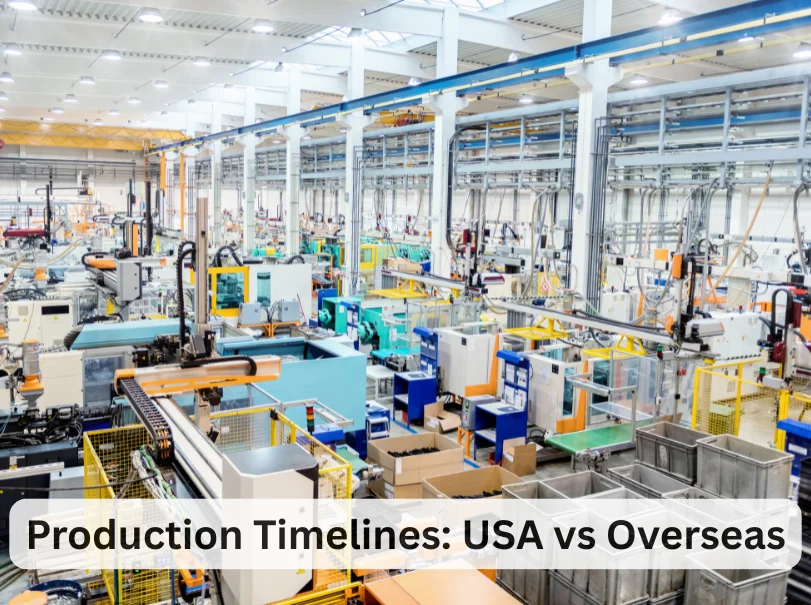
Production Timelines: USA vs Overseas
Time is fashion money. Here is a realistic look at the calendar:
USA Timeline:
- Sampling: 2–4 weeks.
- Production: 4–8 weeks.
- Shipping: 1–5 days.
- Total: ~2–3 months.
Overseas Timeline:
- Sampling: 4–8 weeks (including shipping samples back and forth).
- Production: 60–90 days.
- Shipping (Sea): 30–45 days.
- Customs: 1–2 weeks.
- Total: ~4–6 months.
If you miss a trend while waiting for a shipment from overseas, the lower unit cost doesn’t matter because you can’t sell the product.
How Cord Apparel Helps Brands Manufacture in the USA & Overseas
Navigating the world of USA vs overseas clothing manufacturing can be overwhelming. At Cord Apparel, as a private label manufacturer, we simplify the process by acting as your production partner.
We understand that different stages of business require different solutions.
That is why we offer:
- USA Cut & Sew: Perfect for high-quality, quick-turnaround batches and startups launching their first collection.
- Overseas Partnerships: vetted relationships with ethical factories abroad for when you are ready to scale.
- End-to-End Support: We manage the technical side—from tech pack services to sourcing and QC.
We help you calculate the actual costs and select the factory that aligns with your current budget and future goals.
Final Verdict
So, who wins the battle of clothing manufacturing in the USA vs. overseas?
If you are a funded startup looking to disrupt the mass market, overseas might be your path. If you are a bootstrap founder looking to build a premium brand with lower risk, the USA is the better starting point.
Don’t make this decision based solely on unit prices. Consider your cash flow, your timeline, and your brand values.
Ready to start production, but not sure which path to take?
Compare manufacturing options with us or speak with a manufacturing expert at Cord Apparel today to receive a customized quote for your project.

Leave a Reply