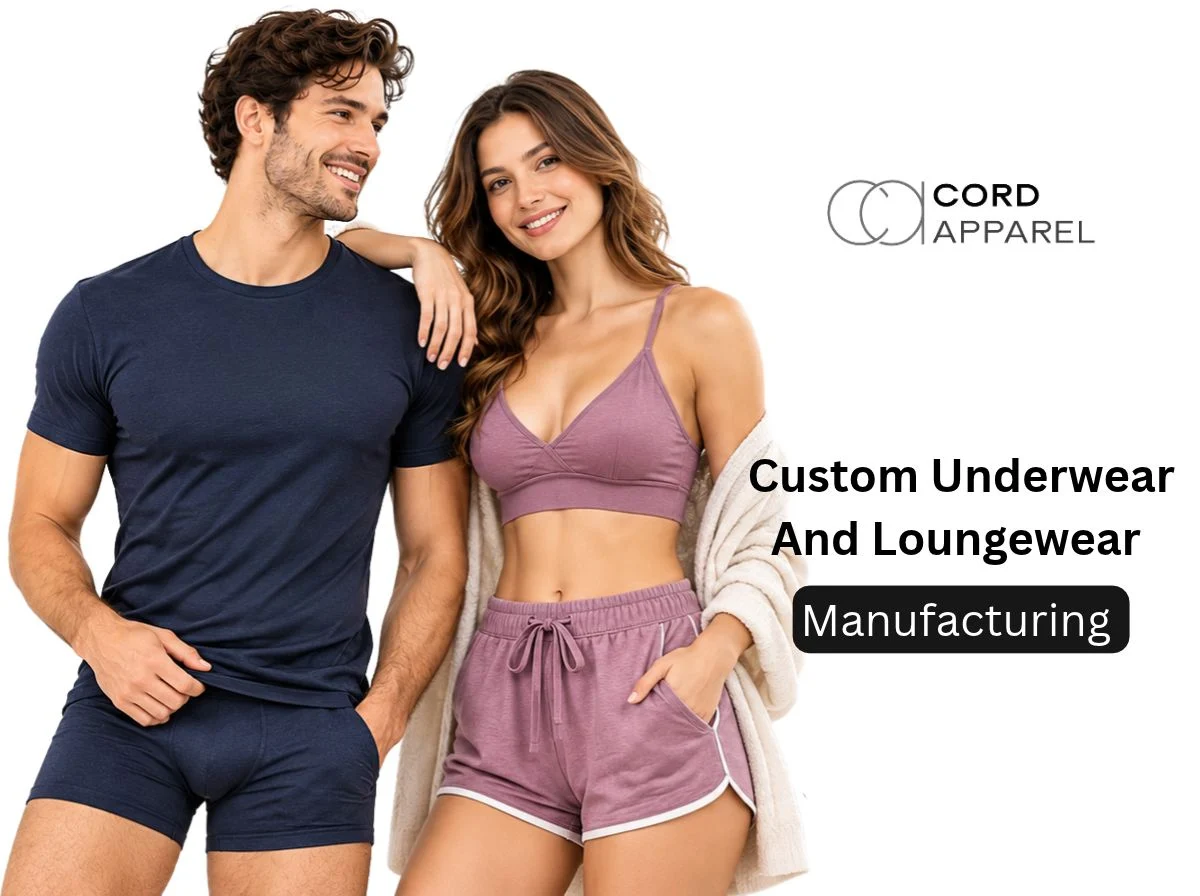
Custom underwear and loungewear manufacturing covers product development, fabric sourcing, pattern making, sampling, fit testing, bulk sewing, quality checks, and packing.
A factory that knows knits and elastics helps a brand build garments that stay comfortable after repeated washing, while cutting down wasted sampling rounds and sizing problems.
Underwear and loungewear used to sit at the bottom of the shopping list. Not anymore. People now buy matching lounge sets the way they once bought jeans, and they care a lot more about what touches their skin for sixteen hours a day.
That change has pulled hundreds of new labels into the category. Most of them run into the same wall. These garments look simply and sew hard. A boxer brief carries a curved gusset, a stretch waistband, and seams that cannot rub.
A lounge set must feel soft on wash twenty, not just on day one. Choose the wrong fabric weight, specify weak elastic, or skip fit testing, and collect returns instead of repeat customers.
What Is Custom Underwear and Loungewear Manufacturing?
It means a factory builds your styles to your own patterns, fabrics, fit, and branding, rather than selling you a stock garment with a logo slapped on it. You have pattern blocks, fabric specs, and the look. The factory owns the engineering and the output.
The three product groups get mixed up constantly, so here is the line between them:
- Underwear sits next to the skin under clothing. Stretch knits, elastic waistbands, gussets, close-fit tolerances measured in millimeters.
- Sleepwear is made for bed. Loose cuts, softer drapes, light fabrics, flammability rules in several markets for children’s ranges.
- Loungewear is worn around the house and now outside it too. Heavier knits, relaxed fit, pockets, drawcords, styling closer to casual wear.
Specialized production matters because knit garments behave nothing like woven shirts. Fabric grows and shrinks, elastic relaxes, and a 5 mm cutting error at the rise changes how the whole garment sits.
Sewing machines are different too: a factory running flatlock, coverstitch, and elastic attachment heads all day gives you clean results, while a woven shirt factory will struggle with the same tech pack.
What this means: pick a factory that already runs your product type daily. Category experience shows up in the first sample.
Types of Underwear Brands Can Manufacture
Most brands launch with two or three styles, prove the fit, then widen the range. Here is what each style asks of the factory.
Boxer Briefs
The volume style in every men’s range. Mid-thigh legs, full coverage, wide branded waistband. Cotton-elastane jersey around 160 to 190 GSM holds its shape well, and modal blends wear cooler. Leg openings are where samples fail, so specify a bonded hem or stretch binding that won’t ride up.
Boxers
Loose fit with a relaxed leg and a button fly in many styles. Popular with older buyers and sleep-focused ranges. Cotton poplin, chambray, and light jersey all suit it. Woven boxers need shrinkage testing before bulk, because cotton poplin can move 3 to 5% after a hot wash.
Briefs
High leg, contoured front, no leg length. A steady seller in multipacks and value ranges. Combed cotton with about 5% elastane gives good recovery. Grading errors show up fast on a small panel, so check the rise measurement on every size.
Trunks
A shorter boxer brief with a square leg. Bought by younger buyers and fashion-led labels. Modal-elastane or micro-nylon sits smooth under slim trousers. Keep leg length proportional across the size run, or larger sizes look stretched.
Bikini Underwear
Low rise, high leg, extraordinarily little fabric. Used in women’s basics and men’s swim-inspired ranges. Stretch jerseys, mesh, and micro-nylon work here. Narrow elastic and soft binding matter more than usual, since every edge sits directly on skin.
Boyshorts
Full seat coverage with a short leg, cut for comfort rather than shaping. It sells well inside sleep and lounge bundles. Rib knit, modal jersey, and cotton-spandex all perform. Add a gusset and keep side seams flat so the garment doesn’t twist after washing.
Thongs
Narrow back panel, minimal coverage, bought for no-show layering under fitted clothing. Micro-mesh, laser-cut jersey, and soft lace are standard. Back elastic tension must be exact because a few millimeters change the whole fit.
Bralettes
Wire-free, pull-on, lined, or unlined. A strong seller across women’s intimates. Rib knit, modal, and power mesh give light support without molded cups. Strap elastic and underband tension decide whether the first sample passes fit testing.
Sports Bras
Compression or encapsulation builds cover low to high impact. Sold into activewear and athleisure ranges. Nylon-spandex, recycled polyester blends, and power mesh are the usual picks. Bonded edges, bartacked straps, and recovery testing after repeated stretching belong in the tech pack.
Shapewear
High-compression pieces that smooth the waist, hip, or thigh. Bought for occasion wear and everyday smoothing. Powernet, high-elastane knits, and bonded panels do the shaping. Panel placement needs several fit rounds on live models, not a dress form.
Types of Loungewear Brands Can Manufacture
Loungewear sells in sets, so plan the range as combinations rather than single pieces. One fabric across three or four styles also lowers your fabric minimum and keeps shade matching easy.
- Lounge sets: A top and bottom cut from the same fabric, sold together. French terry at 240 to 280 GSM works year-round. The two pieces must be cut from the same dye lot or the shades won’t match.
- Pajama sets: Woven or knit, long or short. Cotton poplin, rayon challis, and brushed jersey suit sleep. Children’s sleepwear carries flammability rules in the US and UK, so check before you design.
- Hoodies: The anchor piece of most lounge ranges. Brushed fleece at 280 to 340 GSM gives weight without stiffness. Hood lining, drawcord tipping, and rib quality separate a premium hoodie from a basic one.
- Sweatshirts: Crew neck, no hood, easier to ship and store. Loopback terry breathes better than brushed fleece for spring and autumn ranges.
- Joggers: Tapered leg, elastic waist, cuffed hem. Pair them with the hoodie in the same fabric. Pocket bag placement and rise depth decide whether they look relaxed or shapeless.
- Lounge shorts: Summer volume driver. Light French terry or jersey at 180 to 220 GSM, with a drawcord waist and an inseam between 5 and 7 inches.
- Robes: Waffle knit, terry towel, or brushed fleece. Belt loops, belt length, and shawl collar roll are the three details customers complain about.
- Sleep shirts: Oversized single-piece style, strong in gifting. Modal jersey and washed cotton drape best.
- Tank tops: Rib knit or jersey, sold with shorts or alone. Watch strap width and armhole depth across sizes.
- Matching family sets: Seasonal gifting ranges where adult and child styles share one print. Build the adult pattern first, then grade down and adjust the proportions rather than just shrinking the pattern.
Best Fabrics for Underwear and Loungewear
For underwear, cotton-elastane and modal-elastane knits cover most needs. For loungewear, French terry and brushed fleece do the heavy lifting, with rib knit for trims and fitted pieces. Everything else is a variation on those four.
Fabric weight matters as much as fiber. Underwear sits between 140 and 200 GSM. Lounge tops and joggers run 240 to 340 GSM. Go lighter, and the garment feels cheap; go heavier, and it stops breathing.
| Fabric | Softness | Stretch | Breathability | Moisture | Durability | Eco Option |
|---|---|---|---|---|---|---|
| Cotton jersey | High | Low on its own | High | Absorbs, dries slowly | Good | Organic cotton |
| Organic cotton jersey | High | Low | High | Absorbs | Good | GOTS certified |
| Modal | Extremely high | Low on its own | High | Wicks, dries fast | Medium, pills if low grade | FSC-sourced beechwood |
| Bamboo viscose | Extremely high | Low on its own | High | Good | Medium | Closed-loop processing |
| Cotton-spandex | High | Good | High | Absorbs | Good | Organic cotton base |
| Modal-spandex | Extremely high | Particularly good | High | Dries fast | Medium | Lenzing fibre options |
| Rib knit | Medium to high | Particularly good crosswise | Medium | Average | Particularly good | Organic available |
| French terry | Medium | Low to medium | High | Absorbs well | Particularly good | Organic and recycled blends |
| Brushed fleece | Extremely high | Low | Low | Traps heat | Good, pills if poly-heavy | Recycled polyester |
| Micro nylon-spandex | Smooth | Excellent | Medium | Wicks, dries fast | Very good | GRS recycled nylon |
What this means: ask for fabric swatches washed five times before you approve anything. Hand feel on a fresh swatch tells you extraordinarily little about month three.
Design and Construction Details That Decide Comfort
Customers rarely complain about fabric. They complain about edges, bands, and seams. These are the details worth arguing over in the tech pack.
- Waistband construction: Exposed jacquard elastic carries branding and reads premium. Covered or folded elastic feels softer and costs less. Widths between 30 mm and 40 mm suit most adult underwear.
- Elastic selection: Knitted elastic keeps softness; woven elastic holds tension longer under load. Ask for the elastic recovery rate after stretching, not just its width.
- Gussets: A separate diamond or oval panel at the crotch adds room and airflow. Double-layer cotton gussets are standard in women’s styles for hygiene reasons.
- Flatlock seams: Interlocked stitching that lies flat against skin, used on side seams and leg joints to stop chafing. Slightly slower to sew, worth every second in underwear.
- Overlock stitching: Fast edge finishing for loungewear seams, commonly 4-thread for stretch areas. Fine where the seam sits away from skin.
- Coverstitch hems: Twin-needle finish on hems and waistbands that stretch without snapping threads. Needed anything with elastane.
- Tagless labels: Heat transfer or printed labels inside the waistband. Evaluate adhesion after washing, since cheap transfers peel at the corners within a few months.
- Binding: Narrow fabric or elastic wrapped around leg and neck openings. Keep binding tension even across sizes or the openings cup inward.
- Reinforcement stitching: Bartacks at pocket corners, fly openings, drawcord exits, and strap joins. Small cost, big drop in returns.
- Drawcords and pockets: For loungewear, specify cord length, tipping type, and eyelet placement. Side pocket bags should be cut from lighter fabric, so the garment doesn’t sag.
The Manufacturing Process, Step by Step
From approved concept to shipped cartons, a first production run takes 10 to 16 weeks. Repeat orders run faster because patterns and fabric are already set.
- Product concept: Decide styles, price points, target customer, and season. Bring reference garments you like and ones you hate, since both speed up development.
- Tech pack creation: Flats, measurements per size, fabric and trim specs, stitch types, label placement, and packing instructions. A weak tech pack is the single most common cause of wasted sampling rounds.
- Fabric and trim sourcing: The factory quotes mills, pulls swatches, and confirms minimums. Elastic, drawcords, labels, and polybags are booked at the same time, because trims hold up more orders than fabric does.
- Pattern development: A pattern maker builds the base size, allowing for how much that specific knit stretches and shrinks. Patterns are drafted per fabric, not copied between them.
- Sample production: The first proto comes back in available fabric to check shape and construction. Expect it to be imperfect. That’s the point of it.
- Fit testing: Try the sample on live models in the base size, moving and sitting, not standing still. Measure before and after a wash cycle.
- Product revisions: Comments go back as measured changes, such as lowering the rise by 10 mm, not as vague notes. Most styles settle within two or three rounds.
- Pre-production approval: A sealed sample in final fabric, final color, and final trims. Both sides sign it, and it becomes the reference for every quality check after this.
- Bulk manufacturing: Fabric is relaxed, laid, cut, bundled, and sewn by operation. A pilot runs a few dozen pieces before the full line starts catches problems early.
- Quality inspection: Inline checks during sewing, then a final AQL inspection on finished goods. Sizing, seams, shade, and labeling all get verified.
- Packaging: Folding, polybagging, hangtags, boxed sets, barcode stickers for retail or ecommerce. Packing method affects freight volume, so decide it early.
- Global shipping: Air for speed, sea for cost, with customs paperwork, duty codes, and care labels matched to the destination market.
Common Manufacturing Problems and How to Stop Them
Every failure in this category traces back to a step someone skipped to save two weeks. Here is what goes wrong and what prevents it.
| Problem | Why It Happens | How to Prevent It |
|---|---|---|
| Poor fit | Pattern drafted without accounting for that fabric’s stretch | Fit test on live models in the actual production knit before approval |
| Wrong sizing across the run | Grading rules are copied from another style or another market | Build a size chart for your own customer and check measurements on every size, not just the base |
| Fabric shrinkage | Knit not relaxed before cutting, or no wash test done | Run a wash test on bulk fabric and build the shrinkage allowance into the pattern |
| Weak or dead elastic | Low-grade elastic, or tension set wrong at the machine | Specify elastic by composition and recovery rate, and evaluate after repeated stretch cycles |
| Inconsistent stitching | Operators switching between machines or styles mid-run | Lock the stitch type per seam in the tech pack and run inline checks during sewing |
| Pilling | High polyester content or short-staple yarn | Choose combed or long-staple yarn and ask for a pilling test result before bulk |
| Shade variation between pieces | Set pieces cut from different dye lots | Book one dye lot per color per order and check shade under standard lighting |
| Production delays | Trims ordered late, or sampling rounds stretching on | Book trims with the fabric and cap revisions by agreeing fit comments in writing |
What does this mean: every item above is solved before cutting starts. Once bulk is on the line, your options narrow to rework or discount.
How to Choose the Right Manufacturing Partner
Judge a factory on the sample and the questions they ask you, not on the quote. A supplier who accepts your tech pack without a single question hasn’t read it.
What matters:
- Category experience: Underwear and loungewear are knit and elastic work. A woven shirt specialist will learn from your money.
- Development support: Can they draft patterns and advice on fabric, or do they only sew what you send?
- Fabric sourcing: Direct mill relationships mean better minimums, better pricing, and faster swatches.
- Sampling speed: Ask how long a proto takes and how many rounds are included before charges start.
- MOQ flexibility: Low minimums let you evaluate styles. Cord Apparel starts at 50 pieces, which suits brands launching a first range.
- Quality systems: Ask which AQL level they inspect and whether they do inline checks or only final.
- Communication: One named contact replies within a working day, written confirmations. This predicts your experience better than anything else.
- Room to grow: A factory that manages 50 pieces and 5,000 pieces saves you re-sampling everything when volumes grow.
- Certifications: OEKO-TEX for chemical safety, GOTS for organic content, GRS for recycled claims.
Buyer checklist before you commit
- Request a physical sample of something they already produce
- Confirm MOQ per style, per colour, and per size
- Ask who drafts the pattern and who owns it
- Get sampling lead time and revision policy in writing
- Check which certifications they hold and ask for the certificate number
- Confirm the inspection standard and who pays for rework
- Ask for the payment schedule and what triggers each stage
- Clarify packing, labelling, and shipping terms before production starts
Quality Control Standards Worth Insisting On
Quality control runs across three stages: incoming materials, the sewing line, and finished goods. Checking only at the end means you find faults when it’s too late to fix them cheaply.
- Fabric inspection: Rolls are checked for holes, barré, needle lines, and width variation, commonly using a 4-point system.
- GSM verification: Weigh a cut swatch against the approved spec. A mill shipping 230 GSM against a 260 GSM order changes how the whole garment feels.
- Stretch and recovery testing: Stretch the fabric to a set percentage, release, measure the return. This is what tells you if a waistband will still hold in six months.
- Seam strength: Pull tests on side seams, waistband joins, and strap attachments.
- Measurement checks: Finished garments measured against the size chart, with agreed tolerances, which on underwear run tight at about 0.5 cm.
- Wash testing: Garments washed and dried to the care label instructions, then re-measured for shrinkage and twisting.
- Colorfastness: Rubbing, washing, and perspiration tests, since underwear sits against skin all day.
- Needle detection: Finished goods passed through a metal detector. Required by most retailers and sensible for anything sold to children.
- Final inspection: A random AQL sample of the packed order checked for defects, sizing, and labeling.
- Packaging inspection: Correct size stickers, barcodes, polybag warnings, and carton counts. Mislabeled cartons create warehouse chaos at the other end.
Private Label vs Fully Custom Manufacturing
These four terms get used loosely, and the difference decides your cost, your timeline, and how much of the product is yours.
- Private label: you put your branding on a garment the factory already produces. Fastest route, lowest risk, least differentiation.
- ODM: The factory offers its own developed designs, and you adjust fabric, colour, trims, and fit within limits.
- OEM: you supply the design and tech pack, the factory builds exactly to that spec.
- Fully custom: patterns drafted from scratch, fabric developed or selected specifically, trims made to order.
| Model | Development Cost | Time to Market | Branding Freedom | MOQ | Best For |
|---|---|---|---|---|---|
| Private Label | Lowest | 4 to 6 weeks | Labels, tags, and packaging only | Low | Evaluating a market or adding a basics line |
| ODM | Low | 6 to 10 weeks | Color, trims, some fit changes | Low to medium | New brands wanting a quick, decent product |
| OEM | Medium | 10 to 16 weeks | Full control of design and construction | Medium | Brands with a clear product vision and a tech pack |
| Fully Custom | Highest | 14 to 22 weeks | Total, including bespoke fabric and trims | Medium to high | Established brands building a signature fit |
Many brands start with private labels or ODM to get cash flowing, then move to OEM once they know which styles they sell. That’s a sensible path, not a compromise. Read more on private label clothing manufacturing and cut and sew services.
Sustainable Underwear and Loungewear Production
If you plan to make an environmental claim, back it with a certificate number rather than an adjective. Retailers and regulators both check now.
- Organic fibers: GOTS certification covers organic content plus processing and social criteria. Certification applies to the supply chain, so your factory needs it too, not just the mill.
- Recycled fibers: Recycled polyester and nylon work well in fleece and performance knits. The Global Recycled Standard verifies recycled content through the chain.
- Chemical safety: OEKO-TEX Standard 100 tests finished fabric for harmful substances, which matters more for underwear than almost any other garment.
- Cleaner processing: bluesign screens chemicals, water, and energy use at the mill. Low-liquor dyeing and digital printing both cut water use compared with conventional methods.
- Ethical production: Audited factories, documented wages, reasonable hours. Ask to see the most recent audit report, not a logo on a website.
- Packaging: Recycled or compostable polybags, FSC-certified tags, soy-based inks. Easy wins that customers notice when the parcel arrives.
Cord Apparel’s approach to sustainable production covers eco-friendly materials and fair labor practices across its supply base.
What Drives the Cost per Garment
Two brands can order the same boxer briefly and receive quotes 40% apart. The gap sits in these variables, not in the factory’s goodwill.
- Fabric grade: Combed organic cotton costs more than carded conventional cotton. Yarn quality shows up in pilling, so this is rarely the place to cut.
- Fabric consumption: bigger panels, longer legs and deeper rises all use more cloth. A marker efficiency improvement of a few% moves the unit price.
- Number of colors: Each color has a separate dye lot with its own minimum. Three colors of one style tend to cost more than one color of three styles.
- Custom trims: Branded jacquard elastic, custom woven labels, and bespoke drawcord tips carry their own minimums and tooling charges.
- Printing and embroidery: Screen printing is cheap at volume, embroidery is priced by stitch count, and sublimation needs polyester-rich fabric.
- Packaging: Boxed sets, printed sleeves, and custom polybags add cost per piece and change freight volume.
- Order quantity: Setup time is spread across the run, so 500 pieces always beat 50 unit price.
- Sampling: Protos, fit samples, and pre-production samples carry charges. More revision rounds mean more cost and more weeks.
- Freight and duties: Air freight can double your land cost on heavy loungewear. Sea freight takes longer but keeps the margin intact.
What this means: ask for the quote broken into fabric, trims, cut-make, decoration, and packing. A single lump figure hides where your money goes.
Trends Shaping the Category
What buyers are asking factories for right now:
- Matching sets: Selling a top and bottom together lifts order value and simplifies production planning.
- Gender-neutral ranges: Shared styles with wider size runs and neutral color palettes, which also reduces the number of patterns you maintain.
- Responsible materials: Organic cotton, recycled nylon, and certified viscose moving from niche to expected, particularly in premium ranges.
- Quiet branding: Small tonal logos replacing large waistband wordmarks in the premium end of the market.
- Premium basics: Fewer styles, better fabric, higher price. Customers will pay more for a boxer brief that keeps its shape.
- Seam-free and bonded styles: Circular-knit and bonded construction removing side seams for an invisible look under clothing.
- Comfort-led fit: Softer waistbands, relaxed shaping, less compression. The post-2020 shift that never reversed.
- Functional knits: Moisture management, odour control, and temperature regulation moving from activewear into everyday underwear.
How Cord Apparel Supports Apparel Brands
Cord Apparel works with startups, growing labels, and established brands from its base in Missouri City, Texas, offering both US-focused production and global manufacturing options under the same oversight.
| What Brands Struggle With | How Cord Apparel Manages It |
|---|---|
| An idea with no tech pack | Tech pack development with flats, specs, measurements, and trim details |
| Not knowing which fabric to pick | Fabric sourcing and swatching based on your price point and fit goals |
| Fit problems found too late | Pattern making and sampling that fixes fit before bulk, not after |
| Minimums too high to launch | Low MOQs starting at 50 pieces per style |
| Branding that looks generic | Private label service covering woven labels, printed tags, custom packaging, embroidery, and printing |
| Quality that slips between orders | Checks at multiple stages of production, against a signed reference sample |
| Outgrowing a small supplier | Both small-batch and bulk runs, so repeat orders scale without re-sampling |
Conclusion
Good underwear and loungewear come from unglamorous work: the right knit at the right weight, a pattern drafted for that fabric, elastic that holds, and someone checking measurements before the line runs.
None of them show up in a product photo, and all of them decide whether a customer comes back.
The partner you choose carries most of that risk for you. A factory that knows the category will question your tech pack, push back on a fabric that will pill, and catch a grading error before it becomes 2,000 unsellable pieces.
Planning an underwear or loungewear range?
Send your sketches, reference samples, or tech packs to Cord Apparel at sales@cordapparel.com or call (346) 483-3335 to talk through fabrics, minimums, and timelines for your first run.
Frequently Asked Questions
What is custom underwear manufacturing?
It’s production of underwear built to your own patterns, fabrics, fit, and branding, rather than a stock garment rebelled. You control the design; the factory manages pattern making, sampling, sewing, and quality checks.
How is loungewear manufactured?
Fabric is knitted and dyed, relaxed, then cut and sewn into panels using overlock and coverstitch machines. Trims, labels, and drawcords are added; the garment is checked against a signed sample, then pressed, folded, and packed.
What fabrics are best for underwear and loungewear?
Cotton-elastane and modal-elastane knits suit underwear. French terry and brushed fleece suit loungewear. Rib knit works for tanks, cuffs, and fitted pieces. Micro nylon-spandex covers seam-free styles and shapewear.
What is the difference between private label and custom manufacturing?
Private labels put your branding on a garment the factory already makes. Custom manufacturing builds the garment to your own patterns and specs. Private labels are faster and cheaper; custom gives you a product nobody else sells.
What is the minimum order quantity for custom underwear?
Minimums vary by factory and fabric. Cord Apparel starts at 50 pieces, which lets a new brand evaluate a style before committing to a large run. Custom fabric or custom elastic can raise that minimum.
How long does underwear manufacture take?
The first production run takes 10 to 16 weeks, covering sampling, approvals, fabric booking, bulk sewing, and inspection. Repeat orders run faster because patterns and materials are already confirmed.
What should a tech pack include for underwear or loungewear?
Front and back flats, a measurement chart for every size, fabric composition and GSM, stitch types per seam, elastic specs, trim and label details, colorways, and packing instructions.
What quality tests should underwear undergo before production?
Fabric inspection, GSM check, shrinkage and wash testing, stretch and recovery testing, seam strength, colorfastness to rubbing and perspiration, and measurement checks against the size chart.
Can I use sustainable fabrics for underwear and loungewear?
Yes. Organic cotton, recycled polyester, recycled nylon, and certified viscose all work in this category. Ask for GOTS, GRS, or OEKO-TEX documentation if you plan to put the claim on your website or labels.
How much does custom underwear manufacturing cost?
Cost depends on fabric grade, fabric consumption, number of colours, custom trims, decoration, packaging, and order quantity. Ask for a quote broken down by component rather than a single figure, and compare on the same spec.
Does Cord Apparel manufacture custom underwear and loungewear?
Yes. Cord Apparel produces underwear, loungewear, pajamas, bras, and lingerie, alongside wider apparel categories, with private label and custom options.
Can Cord Apparel assist with product development and fabric sourcing?
Yes. Product development, sampling, fabric sourcing, and quality control are part of the service, so brands without an in-house technical team can still get a production-ready garment.
How many samples should brands approve before bulk production?
Most styles need two or three rounds: a first proto, a corrected fit sample, then a pre-production sample in final fabric and trims. That last one gets signed and becomes the reference for inspection.
What should I look for when choosing an underwear manufacturer?
Category experience with knits and elastics, pattern-making ability, fabric sourcing, sampling speed, MOQ flexibility, documented quality checks, certifications, and clear communication. Ask for a physical sample before committing.
How do I request a manufacturing quote from Cord Apparel?
Send your sketches, reference images, or tech pack through the quote form on cordapparel.com, or email sales@cordapparel.com. Include styles, quantities, target fabric, and your launch date.
Leave a Reply