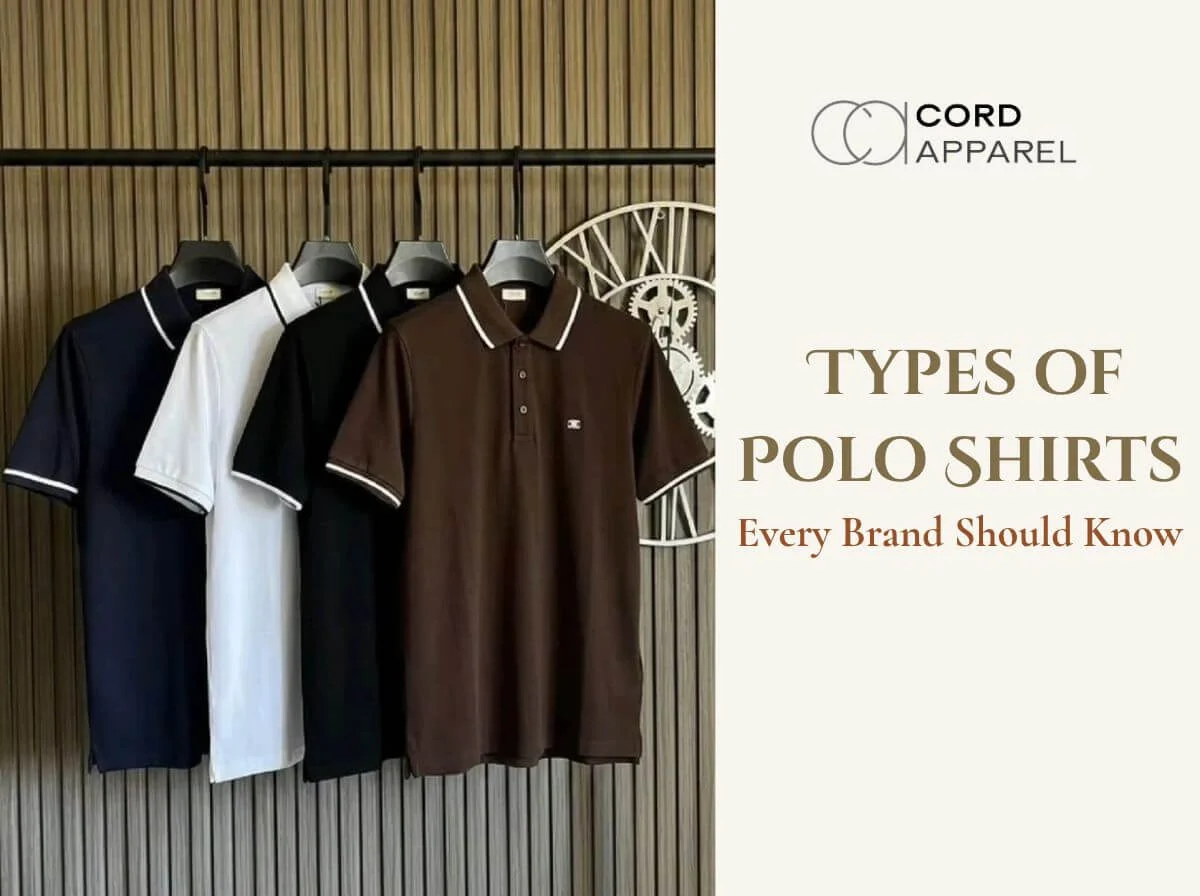
Polo shirts come in many styles, including classic piqué, jersey, performance, long sleeve, golf, rugby, corporate uniform, fashion, luxury, and sustainable polos. Each differs in fabric, knit structure, fit, and construction, so brands should pick a style based on their target market, price point, and how the shirt will be worn.
Polo shirts keep selling because they sit between two worlds. They feel like a T-shirt but look presentable enough for a client meeting, a golf course, or a hotel front desk.
That is why retail labels, uniform programs, golf clubs, schools, restaurants, and promotional companies all move polos in volume. The global polo market sits near $6 billion and grows at roughly 2.7% a year, with office-casual wear pulling most of that demand.
A polo looks simple from the outside. Underneath sit knit structure, yarn count, GSM, collar build, shrinkage control, and decoration method. Get those wrong and your customer notices after three washes, not in the fitting room.
What Is a Polo Shirt?
A polo shirt is a knit collared shirt with a short, buttoned placket and a softer build than a woven button-down. The collar and cuffs are knitted separately and sewn on, which holds the shape and stops the neckline from stretching.
Five parts define it: a knit body in piqué or jersey, a collar that stands on its own, a placket that buttons partway down the chest, short or long sleeves, and a longer back hem (the tennis tail) that stays tucked.
The design came from two sports. British officers playing polo in 19th-century India buttoned their collars down to stop them flapping.
René Lacoste then cut a short-sleeved piqué shirt for tennis, wore it at the 1926 US Open, and sold it from 1933. It still sells because no other knit top carries a logo this well: the chest panel sits flat and holds embroidery without puckering.
Types of Polo Shirts
Fourteen styles matter commercially. Some are defined by fabric, some by the job the shirt does.
Classic Piqué Polo
Textured waffle knit, the original polo fabric and still the biggest seller. Retail runs 180 to 220 GSM, uniform 220 to 260 GSM. The texture hides creases but breaks up fine print detail, and low-grade piqué pills at the underarm within a season.
Best for: retail basics, corporate uniforms, promotional runs.
Jersey Polo
A flat single knit, same structure as a T-shirt. Softer, closer drape, and it takes print cleanly. You pay in wrinkle memory and hem curling when finishing is rushed. Runs 160 to 200 GSM.
Best for: DTC fashion, resort collections, garment-dyed styles.
Performance Polo
Polyester or poly-spandex with a wicking finish. Ask whether the wicking is topical (it fades after 30 to 50 washes) or engineered into the fiber. Lightweight at 140 to 180 GSM and fast-drying. Weak versions trap odor.
Best for: golf, sports teams, outdoor crews, hospitality.
Cotton Polo
Quality lives in the yarn: carded open-end goes fuzzy, combed ring-spun stays smooth, mercerized cotton adds sheen and deeper color. Untreated knit cotton shrinks 5 to 7%, and compacting pulls that under 3%.
Best for: premium retail, heritage labels, anything sold on hand feel.
Polyester Polo
Holds shape, dries fast, and takes sublimation printing, which cotton cannot. Color stays locked through industrial washing at a lower piece cost. It breathes less, and dark shades on cheap yarn look shiny.
Best for: team kits, sublimated designs, high-wash uniform programs.
Cotton-Poly Blend Polo
The workhorse: 60/40, 50/50, and 65/35. A 50/50 moves 2 to 3% after washing against 5% or more for pure cotton, which is why reorder-driven buyers stay with blends.
Best for: corporate uniforms, schools, hospitality, promotional apparel.
Long Sleeve Polo
Wrist length with a rib cuff. The armhole and sleeve cap need redrafting, not just lengthening, or the sleeve binds at the bicep. Rib cuffs grip and lose elasticity; a self-fabric hem looks cleaner and rides up.
Best for: cold-season retail, hospitality, healthcare, sun-exposed crews.
Golf Polo
Built around a swing: lower armhole, side vents, longer tail, moisture management, UPF 30 or higher. Insist on four-way stretch, because two-way restricts shoulder rotation and your customer feels it on the first tee.
Best for: golf retail, club shops, corporate golf days.
Fashion Polo
Anything off the standard block: rib bodies, cropped and boxy cuts, camp collars, contrast tipping, buttonless pullovers. Margins run higher and so do risk since these sell inside a trend window. Test at 100 to 300 pieces.
Best for: DTC labels, boutique retail, seasonal drops.
Rugby Polo
Cotton jersey at 280 to 320 GSM with a woven twill collar, rubber buttons that will not snap, and taped shoulder seams. Built to be grabbed without tearing. You pay for shipping weight and drying time.
Best for: premium casual retail, outdoor workwear, club merchandise.
Corporate Uniform Polo
Wash durability, color consistency across reorders, sizes XS to 5XL, and a flat chest panel for embroidery. Specify Pantone TCX from day one and keep the approved lab dip on file, because that step prevents most reorder complaints.
Best for: hotels, restaurants, retail staff, field service teams.
Athletic Polo
Raglan sleeves, mesh panels, flatlock seams, shorter tail, 130 to 160 GSM. The detail brands skip is seam type: overlocked seams chafe during sustained movement, while flatlock costs more and prevents the returns.
Best for: tennis and padel clubs, team kits, fitness staff.
Luxury Polo
Fiber, finishing, and trim set this apart, not the logo. Long-staple or mercerized cotton (Supina, Egyptian), merino, or silk-cotton, knitted in 40s and 50s yarn against the 20s and 30s used mid-market. Corozo buttons, a hand-linked collar, a French placket.
Best for: luxury menswear, resort labels, private clubs, high-margin DTC.
Sustainable Polo
Organic cotton, recycled polyester, bamboo viscose, or regenerative cotton with low-impact dyes and a certified chain of custody. Textile Exchange found recycled fibers held about 7.6% of global fiber production in 2024, all from bottles rather than old clothing, so claims need documents behind them. Ask for GOTS or OCS, GRS or RCS, and OEKO-TEX Standard 100.
Best for: brands with environmental targets, procurement buyers, European retail.
Polo Shirt Fabrics
Fabric decides how your polo feels, how long it survives, and what it costs to make. Everything else is adjustment around that choice.
| Fabric | Comfort | Durability | Breathability | Wrinkle Resistance | Cost | Best Use |
|---|---|---|---|---|---|---|
| Piqué Cotton | High | Medium–High | High | Medium | $$ | Retail basics, uniforms |
| Jersey Knit | Extremely High | Medium | Medium–High | Low | $$ | Fashion, resort, DTC |
| Interlock | Extremely High | High | Medium | High | $$$ | Premium polos, kidswear |
| Polyester | Medium | High | Low–Medium | Extremely High | $ | Teams, sublimation, heavy-wash applications |
| Cotton-Poly Blend | High | High | Medium | High | $ | Corporate apparel, schools, promotional clothing |
| Bamboo Viscose | Extremely High | Medium | High | Medium | $$$ | Premium soft-hand apparel lines |
| Organic Cotton | High | Medium–High | High | Medium | $$$ | Certified eco-conscious retail |
| Recycled Polyester | Medium | High | Low–Medium | Extremely High | $$ | Sustainable sportswear and uniforms |
GSM is the number to pin down. Two pools, both called piqué cotton, can be 170 GSM and 240 GSM. Write the target into your tech pack with a tolerance of plus or minus 5%, or the bulk will not match the sample you approved.
Polo Shirt Fits
Fit causes more returns than fabric does.
| Fit | Cut | Who Buys It |
|---|---|---|
| Classic | Straight through the chest and waist | Uniform programs, 40-plus retail, and wide size runs |
| Regular | Light shaping, standard armhole | Mass retail, promotional orders, and brands seeking a safe default |
| Slim | Tapered waist, higher armhole | Fashion DTC brands, younger menswear labels, and European retail |
| Athletic | Broad chest, tapered waist | Golf, gym, teamwear, and sports brands |
| Relaxed | Wider body, softer shoulder line | Resort wear and comfort-focused clothing lines |
| Oversized | Boxy shape, longer body, dropped shoulders | Streetwear brands, unisex collections, and younger buyers |
Grade rules change with the fit. A slim polo graded on classic increments goes shapeless at 2XL and 3XL because the waist suppression stops scaling. And a women’s polo is not a smaller men’s polo: it needs a different armhole, bust shaping, a shorter body, and a narrower shoulder.
Polo Shirt Collar Types
The collar is where cheap polo gives itself away. It is the first part to curl, wave, or go limp.
Rib knit collar: Knitted as a tube, cut to length, sewn on. Lowest cost and most common, and it waves at the edge after repeated washing unless the rib is dense and stabilizer tape runs along the seam.
Flat knit collar: Knitted to shape, so edges are finished rather than cut. Holds form far longer and accept tipping stripes. This is the collar on golf and premium polo.
Self-fabric collar: Cut from the body fabric. Soft and casual on jersey and fashion polos, but it drapes instead of standing, so treat it as a style call.
Contrast collar: Any of the above in a second color or tipped. Watch dye lot matching and insist on a crocking test, because dark tipping on a light collar bleeds when the dye is not fixed.
The spec that prevents collar failure: 1×1 rib at 2.5 times the body GSM, plus twill tape along the neck seam.
Polo Shirt Sleeve Options
Short sleeve: The default, 8 to 9 inches from the shoulder point on a men’s medium.
Long sleeve: Wrist length with a rib cuff, and it needs its own sleeve cap draft.
Raglan sleeve: The seam runs from underarm to neckline instead of the shoulder. More rotation, no seam under a bag strap, and an instant signal that the shirt is sportswear.
Set-in sleeve: The classic build with the seam on the shoulder line. Cleaner silhouette for corporate looks.
Contrast sleeve: A second color on the sleeve or cuff band. Low-cost differentiation for club and team programs.
Cuffed sleeve: A rib band at the opening. Pure cotton cuffs relax over time, and 3 to 5% elastane in the cuff yarn solves it.
Polo Shirt Placket Styles
Two-button: Shorter opening, cleaner front, reads more formally. Common on corporate and golf polos.
Three-button: Longer opening, traditional, easier to pull on. The standard for classic retail.
Hidden placket: Buttons behind a flap so nothing interrupts the chest. Suits luxury styles and adds labor cost.
Zip placket: A quarter-zip or short zip, strong in golf and performance. Specify a branded zipper and a chin guard.
Open placket: The Johnny collar: no buttons, just a soft V. Resort-driven, and one of the fastest moving variations right now.
Interlining decides whether a placket sits flat or ripples. Woven holds shape on a knit body, while fusible can bubble after a few washes. Length on a men’s medium runs 5.5 to 7 inches.
Decoration Methods for Polo Shirts
Your decoration method must suit the fabric. Pairing the wrong two is how brands end up with cracked logos and reprint bills.
| Method | Best Suits | Durability | Practical Minimum | What to Watch Out For |
|---|---|---|---|---|
| Embroidery | Piqué, cotton blends, and interlock | Extremely high | 25 pieces | Puckering on lightweight jersey fabrics |
| Screen Printing | Flat jersey and polyester | High | 50 pieces | Fabric texture can reduce detail on piqué |
| Heat Transfer / DTF | Almost any fabric, subject to transfer compatibility | Medium | 1 piece | Edges may lift after repeated washing |
| Sublimation | White or light-colored polyester | Permanent when properly applied | 50 pieces | Not suitable for cotton or dark-colored base fabrics |
| Woven Labels | Garment hems, collars, and sleeves | Extremely high | 100–500 pieces | Supplier lead times can affect production schedules |
| Rubber or Silicone Patches | Most fabrics, depending on attachment method | High | 100–300 pieces | Can feel stiff on soft, lightweight knits |
Embroidery is the polo standard. A left chest logo 3 to 3.5 inches wide runs 5,000 to 9,000 stitches. Specify cut-away backing on knit, not tear-away, or the stitch field shifts and the logo distorts. On piqué below 180 GSM, drop the density or the texture flattens into a shiny patch.
Sublimation only works on polyester. It dyes fiber so it never cracks, but it cannot print cotton and cannot print white, so your base must start light. Woven labels and rubber patches protect the margin better than a printed logo, and they make a private label polo look like your product rather than the factory’s stock style.
How to Choose the Right Polo Shirt for Your Brand
Work backwards from two answers: who wears the shirt, and who pays for it.
| If You Sell To | Style | Fabric | GSM | Fit | Decoration |
|---|---|---|---|---|---|
| Corporate Uniform Buyers | Classic Piqué | 60/40 Cotton-Polyester | 200–220 | Classic | Embroidery |
| Golf and Club Retail | Golf Performance Polo | Polyester-Spandex | 150–170 | Athletic | Embroidery and Heat Transfer |
| Premium DTC Menswear | Luxury or Jersey Polo | Mercerized or Supima Cotton | 200–240 | Slim or Regular | Woven Label and Small Embroidery |
| Promotional and Event Businesses | Blend Piqué | 50/50 Cotton-Polyester | 180–200 | Regular | Screen Printing or Embroidery |
| Streetwear Brands | Fashion or Oversized Polo | Heavy Jersey or Rib Knit | 220–280 | Oversized | Rubber Patch or Print |
| Sports Teams | Athletic Polo | 100% Polyester | 140–160 | Athletic | Sublimation |
| Hospitality Businesses | Long-Sleeve or Classic Polo | Poly-Cotton | 200–220 | Classic or Relaxed | Embroidery |
Price sets the ceiling. If your retail price is fixed, pick the fabric that still leaves budget for the collar and trim, because those are the parts customers touch first.
Volume decides your options. Below 500 pieces, you buy stock fabric and live with its GSM and shade range. Above 1,000 per color, mills knit to your spec. Intended use overrides taste too: a 100% cotton polo is the wrong answer for a kitchen crew washing shirts five times a week.
Manufacturing Considerations
- Fabric sourcing: Mills hold minimums, commonly 300 to 500 kg per color. Write the mill name and article number into your tech pack so a substitution cannot happen quietly.
- Pattern making: Each fit needs its own block, and the collar and placket pieces carry the most tolerance risk.
- Collar construction: Settle rib versus flat knit before sampling, because switching later resets cost and timeline.
- Color matching: Pantone TCX references, lab dips approved under D65 lighting, signed swatch kept for reorders.
- Shrinkage control: Compact or sulfurize knit cotton before cutting and build residual shrinkage into the pattern.
- Stitch quality: 12 to 14 stitches per inch on main seams, double-needle cover stitches at hems, barracks at the placket base.
- Sampling: Proto, fit sample, pre-production. Approve the PP sample in actual bulk fabric, never a substitute.
- Bulk production: Request an inline inspection at around 20% of output. A collar fault caught at piece 200 is cheap; at piece 2,000 it is not.
- Quality control: Final inspection against AQL 2.5 for major defects, written into the purchase order.
Common Mistakes Brands Make
Choosing fabric from a photo: Hand feel does not travel through a screen. Order a header card first.
Ignoring shrinkage: Ask for wash-tested measurements, never cut measurements.
Accepting a weak collar: A soft rib collar on a 200 GSM body waves inside a season.
Copying another brand’s size chart: Their fabric stretches differently. Build yours from your own fit samples and return data.
Approving embroidery as a file: A digitized logo looks clean on screen and puckers on knit. Get a sew-out on bulk fabric first.
Picking the fit you personally wear: Slim fits perform in fashion retail and fail in uniform programs.
Skipping wash testing: Colorfastness, pilling, and spirality all appear after washing, which is when your customer finds them instead of you.
Quality Control for Polo Shirts
Every check below maps to a complaint you would otherwise receive from a customer.
| Check | What It Catches | Standard | Target |
|---|---|---|---|
| Fabric Inspection | Holes, barre, needle lines, and shade bands | 4-Point System | Under 20 points per 100 sq. yd. |
| GSM Verification | Fabric knitted at a lower weight than specified | Weighed Cut Samples | Within 5% of specification |
| Colorfastness to Washing | Dye bleeding onto other garments | AATCC 61 | Grade 4 or higher |
| Colorfastness to Crocking | Dye rubbing off under dry or wet conditions | AATCC 8 | Grade 4 or higher |
| Shrinkage | Size changes after laundering | AATCC 135 or AATCC 150, as applicable | Under 3% after three washes |
| Pilling | Fuzzing and pill formation around underarms and side seams | ASTM D3512 | Grade 4 or higher |
| Spirality | Side seams twisting after washing | AATCC 179 | 5 degrees or less |
| Seam Strength | Shoulder and armhole seams splitting under stress | ASTM D1683, where applicable | Meets buyer specifications |
| Measurement Check | Size variations across the production run | Approved Size Chart | Within specified measurement tolerances |
Collar stability needs its own check. Wash three finished polos three times, dry them normally, then look at the collar edge under good light. Waving and loose ribs show up here and nowhere earlier. Inspect packed goods as well, since mis-sorted sizes and packing damage only exist after the garments are bagged.
Sustainable Polo Shirt Manufacturing
Demand for certified polos is strongest in European retail and corporate procurement, where buyers ask for documents alongside samples.
Organic cotton: GOTS or OCS certified, at a 20 to 40% premium at yarn stage. Better Cotton is cheaper but runs on mass balance rather than physical traceability, so word your hangtag accordingly.
Recycled polyester: Mostly from PET bottles, performs close to virgin polyester in polo knits, certified under GRS or RCS.
Dyeing and water: Reactive dyes with high fixation rates cut water use and rinse cycles. Cold pad batch dyeing and reclaimed water systems cut consumption further at mill level.
Ethical manufacturing: WRAP, SEDEX SMETA, and amphora BSCI audits cover working conditions, and uniform tenders ask for these by name.
Eco-friendly trims: Corozo buttons, recycled polyester thread, FSC hangtags, recycled poly bags. Small items, and the first thing an environmentally minded customer picks up.
How Cord Apparel Manufactures Custom Polo Shirts
Most polo problems trace back to one cause: nobody was managing the gap between the tech pack and the sewing line. Here is how Cord Apparel closes it.
| What Goes Wrong | How We Manage It |
|---|---|
| The sample looks nothing like the reference. | Development starts with your reference garment, header cards, and a written tech pack before anything is cut. |
| Fabric arrives at the wrong GSM or in the wrong shade. | We source against your specifications, verify GSM and shade on arrival, and keep the approved lab dip on file. |
| Fit falls apart in the larger sizes. | Pattern making and grading are completed for each block and checked across your full size range. |
| The first order is great, but the third order is different. | Approved samples, lab dips, and measurement charts stay on record to help maintain consistency across repeat batches. |
| The MOQ is too high to evaluate a style. | Minimums start at 50 pieces, allowing you to trial a polo style before committing a larger stock budget. |
| Branding looks cheap on the finished shirt. | Embroidery, screen printing, sublimation, woven labels, and custom packaging are managed in-house. |
Cord Apparel runs OEM and ODM programs, private label production, and full cut-and-sew manufacturing from its base in Missouri City, Texas, with USA-focused and global production routes, all under one point of contact.
Conclusion
The polo type you choose are three decisions bundled together: what the shirt is made of, how it is built, and who wears it. Line those up and the rest of the specification writes itself.
A piqué uniform polo and a mercerized cotton retail polo are not competing products, and asking one shirt to do both jobs is how brands end up with something nobody is happy with.
What most underestimate is consistency across orders: a beautiful first sample counts for little if order three looks different from order one.
If you are developing a polo line, Cord Apparel can take it from reference garment to packed cartons. Send your tech pack, a sample shirt, or an idea to sales@cordapparel.com or call (346) 483-3335 for pricing and a sampling timeline.
Frequently Asked Questions
What are the main types of polo shirts?
Classic piqué, jersey, performance, cotton, polyester, cotton-poly blend, long sleeve, golf, fashion, rugby, corporate uniform, athletic, luxury, and sustainable polos.
What is the difference between piqué and jersey polo shirts?
Piqué has a textured waffle surface that hides wrinkles, while jersey is flat and smooth, feels softer, and takes print better.
Which fabric is best for custom polo shirts?
A 60/40 cotton-poly piqué at 200 to 220 GSM suits most brands, and premium retail does better on mercerized or Supina cotton.
What is a performance polo shirt?
A polo in polyester or poly-spandex with a moisture-wicking finish, four-way stretch, and often UPF protection.
What type of polo shirt is best for corporate uniforms?
A cotton-poly blend piqué at 200 to 220 GSM with a dense rib or flat knit collar, because it survives frequent washing and holds color across reorders.
What fit should clothe brands choose for polo shirts?
Regular fit for broad retail, slim or oversized for fashion labels, and classic fit up to 4XL or 5XL for uniform programs.
How do you choose the right polo shirt fabric?
Start with washing frequency and price point: frequent washing points to blends or polyester; a premium price with less washing points to cotton.
Can polo shirts be customized with embroidery or printing?
Yes. Embroidery is the standard, screen printing suits flat jersey, sublimation works on light polyester, and heat transfer covers small runs.
What is the difference between cotton and polyester polo shirts?
Cotton breathes better and feels softer but shrinks and creases more, while polyester holds shape, dries fast, resists fading, and takes sublimation.
What quality checks are important during polo shirt manufacturing?
Fabric inspection, GSM verification, colorfastness, shrinkage, pilling, spirality, seam strength, collar stability, and final measurement checks.
Does Cord Apparel manufacture custom and private label polo shirts?
Yes, including custom development, private label production, OEM and ODM programs, and bulk manufacturing with your own labels and packaging.
What is the minimum order quantity for custom polo shirts?
Cord Apparel starts at 50 pieces, though custom knitted fabric, and exact Pantone matching need higher volumes per color.
Can Cord Apparel help with fabric sourcing and product development?
Yes. Sourcing, tech pack development, pattern making, and sampling are part of the service, so a sketch is enough to start.
How long does custom polo shirt production take?
Sampling runs around 10 to 15 days per round, and bulk takes 30 to 45 days after sample approval.
How do I get a quote for custom polo shirt manufacturing?
Send your tech pack, reference garment, target quantity, and fabric preference to sales@cordapparel.com or call (346) 483-3335.

Leave a Reply