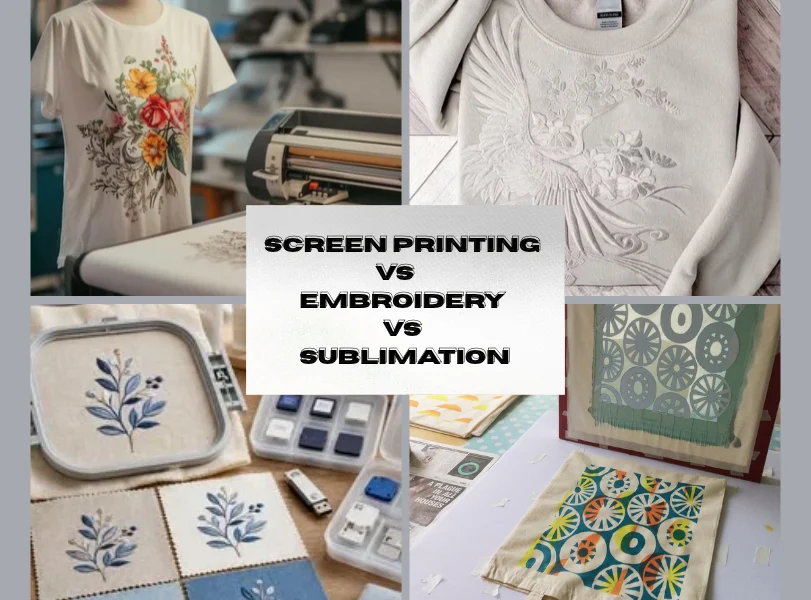
Your logo is the first thing a customer touches. A cracked print on a premium hoodie tells a story you never wanted to tell, and a stiff embroidered patch on a running singlet feels wrong the moment someone pulls it on. Buyers register these details fast, even if they never say it aloud.
Branded apparel has become a real revenue line for gyms, coffee shops, sports clubs, and clothing labels, not a throwaway giveaway. That shift raised the bar on finish quality. Decoration now sits beside fabric and fits as a reason people buy a second time.
Screen printing, embroidery, and sublimation each solve a different problem, and picking the wrong one shows up in your return rate, not just your invoice.
What Are the Most Popular Apparel Customization Methods?
Three processes cover most commercial garment decoration: screen printing, embroidery, and sublimation. Each puts artwork on fabric in a completely different way, and the difference is physical, not cosmetic.
Screen printing pushes ink through a mesh stencil onto the face of the fabric. The ink sits on the surface and is cured with heat.
Embroidery stitches the design into the garment with thread. No ink is involved, so the logo is built from raised stitches you can feel with your thumb.
Sublimation turns solid dye into gas under heat and pressure. The dye bonds inside polyester fibers, so nothing sits on top of the cloth.
Two more methods show up in quotes: heat transfer and DTF printing. Both press a printed film onto fabric, and both manage short runs and complicated artwork well, though neither beats screen printing on cost once cotton orders get large.
Trends push brands toward whatever photographs well. Production rewards a different question: what is this garment made of, how will it be washed, and how many pieces are you ordering?
How Does Screen Printing Work?
Screen printing forces ink through a fine mesh screen with your design burned into it as a stencil. One screen carries one color.
A four-color logo means four screens, four setups and four passes on the press, each aligned so the colors register cleanly.
Most production runs on plastisol ink, which cures at 320°F in a conveyor dryer. Cured correctly, it lasts for years. Under-cured ink cracks within a few washes, and that is where cheap printing exposes itself.
Ink choice changes how the finished garment feels:
- Plastisol: bright, opaque, strong on dark fabric
- Water-based: sinks into the fibers for a soft, worn-in finish
- Discharge: strips the garment dye and replaces it with pigment, leaving almost no hand feel on 100% cotton
- Puff: rises off the surface for a thick, textured logo
It works best on flat panels that lie on a platen: T-shirts, hoodies, sweatshirts, and tote bags. Cotton and cotton-rich blends hold ink best and keep Pantone matching accurate.
The limits are straightforward. Every added color adds setup cost. Photographic gradients need simulated process separations and a skilled press operator. Prints across zippers, thick seams, or pockets stay risky.
On quantity, screen printing starts paying off around 50 pieces per design and keeps getting cheaper per unit, because that fixed setup spreads across more garments.
How Does Embroidery Work?
Embroidery starts with digitizing, which is different from uploading a logo file. A digitizer rebuilds the artwork as a stitch file that tells the machine where every needle lands, in what order, and in which direction. Small text and tight curves are where a good digitizer earns the fee.
Three stitch types do the work:
- Satin stitch: smooth and glossy, used for lettering, borders, and narrow shapes
- Fill stitch: rows of short stitches that cover large areas with a woven texture
- Run stitch: single-line outlines and fine detail
Thread choice decides how the logo ages. Polyester thread survives industrial laundering and bleach, which is why corporate uniform programs rely on it. Rayon carries a softer shine and suits retail and fashion pieces where wash cycles are gentler.
Placements that read well: left chest, sleeve, back yoke, cap front, collar band, cuff, and the hip of joggers. Anywhere the fabric sits stable enough to hoop.
The limits are honest ones. Lettering below about 5mm fills in and stops being readable once thread builds up. Photographic images, gradients, and blended color do not convert to thread.
Dense stitching on lightweight knits puckers, and high stitch counts add weight, which is why oversized back logos rarely work in embroidery.
Small orders suit embroidery, since setup is a one-time digitizing charge rather than a per-color screen.
How Does Sublimation Printing Work?
Sublimation prints your design onto transfer paper using disperse dyes. A heat press at 400°F then turns that solid dye straight into gas.
Under pressure, the polyester fibers open, the gas moves in, and the fibers close around it as they cool. The dye becomes part of the fiber itself.
That is why a sublimated jersey feels identical to a blank one, and why the print cannot crack or peel. There is no surface layer to fail.
Two hard rules come with the process:
- The fabric needs high polyester content, ideally 100%, because dye bonds with polymer and ignores cotton.
- The garment also needs to be white or exceptionally light, since sublimation ink is transparent and cannot print white or cover a dark base.
What it does better than any other method: prints that run seam to seam, photographic imagery, CMYK gradients, all-over patterns, and names and numbers on team kits.
For activewear and jerseys, fabric panels can be printed flat before cutting and sewing, which puts color right to the edge with no break at the seam.
The fabric limits bite elsewhere. Cotton holds nothing. Blends fade in proportion to their cotton share. Seams and underarm zones can show light patches where press pressure drops, and heat-sensitive performance fabrics need tested press settings before bulk runs.
Screen Printing vs Embroidery vs Sublimation: Side by Side
| Factor | Screen Printing | Embroidery | Sublimation |
|---|---|---|---|
| Best Fabrics | Cotton, cotton-rich blends | Twill, piqué, fleece, woven | 100% polyester, white or light |
| Durability | 3 to 5 years when cured correctly | Outlasts the garment | Lasts as long as the fabric color |
| Appearance | Flat, bold, graphic | Raised, textured, premium | Smooth, photographic, no hand feel |
| Color Options | Spot colors, accurate Pantone matching | Limited to thread shades | Unlimited CMYK and gradients |
| Setup Cost | Per screen, per color | One-time digitizing charge | Low setup |
| Small Orders | Weak below 50 pieces | Strong | Strong |
| Large Orders | Cheapest per unit | Price stays flat | Price stays flat |
| Full-Color Artwork | Needs simulated process separations | Not suitable | Ideal |
| Performance Apparel | Can feel stiff over wicking fabric | Adds weight, risks puckering | Built for it |
| Corporate Apparel | Good for event tees and bags | First choice for polos and shirts | Only on polyester uniforms |
| Sports Uniforms | Numbers crack under heavy stretch | Crests and badges | Standard for full kits |
| Fashion Brands | Core method for graphic tees | Logo detail, caps, outerwear | All-over prints and capsule drops |
Which Fabrics Work Best with Each Method?
Fabric decides more than artwork does. Here is how the common ones behave on the floor.
Cotton: Screen printing territory. Ink keys into the fiber, colors stay true, and discharge printing is available on 100% reactive-dyed cotton for a finish with almost no hand feel. Sublimation does nothing on cotton at all.
Polyester: Sublimation lives here. Screen printing on polyester needs low-bleed ink or a poly blocker; otherwise, garment dye migrates up into the print, and white ink turns pink on red fabric weeks after delivery.
Cotton and poly blends: Screen printing and embroidery both behave well. Sublimation on a 50/50 blend gives a washed, faded look, which is a problem unless that vintage effect is exactly what you briefed.
Moisture-wicking performance fabrics: Sublimation first. Embroidery works with a light stitch count and no-show mesh backing, though heavy stitching interrupts the wicking structure. Water-based inks keep screen prints breathable.
Fleece: Embroidery needs a water-soluble topping, so stitches do not sink into the pile. Screen prints need a higher mesh and a firmer hand to sit above the surface.
French terry: The loop side behaves like fleece and needs extra flash curing. The flat face takes embroidery cleanly.
Jersey knit: It stretches, so prints need a stretch additive, and embroidery needs cut-away backing to stop the logo distorting after a few wears.
Fabric and decoration get chosen together during cut and sew development, never after.
Cost Comparison
None of these methods has a fixed price. Each one is priced off a different variable and knowing which variable you are paying for is how you control the quote.
Screen printing charges per screen, per color, per design. A one-color logo on 500 tees is one of the cheapest decorations in apparel. The same artwork in six colors on 40 tees is one of the most expensive per piece. Print size barely moves the number; color count moves it a lot. Specialty inks such as discharge, puff and metallic add a step to the press run.
Embroidery is priced by stitch count, usually in blocks of a thousand stitches, plus a one-time digitizing charge. Thread colors are free, so a twelve-color crest costs no more than a two-color one at the same size. Design size and fill density are what drive stitch count upward.
Sublimation is priced by printed area and ink coverage. Photographic artwork costs the same as a flat shape, and there is no per-color charge at all. All-over printing raises cost because panels are printed before assembly, which adds cutting and sewing work.
The costs brands forget sampling, rerunning a job because artwork arrived at low resolution, rush production, and extra placements, since every placement is a separate machine pass.
Durability and Wash Performance
Durability depends less on the method than on whether the method was executed properly.
Screen printing
A correctly cured plastisol print survives years of normal wear. Cracking traces back to one of three causes: under-curing, printing too thick a deposit, or stretching the print beyond what the ink film allows.
Washing cold and inside out, skipping fabric softener and drying low extends print life noticeably. PRINTING United Alliance, which absorbed the Specialty Graphic Imaging Association, publishes the technical guidance most serious print shops follow on curing and testing.
Embroidery
Thread does not crack, peel, or fade the way ink can, so embroidery usually outlives the garment it sits on. Failure shows up as a snagged thread or exposed backing, not as a faded logo.
Polyester thread holds color through bleach and industrial laundering. Loose threads get trimmed, never pulled.
Sublimation
The dye is inside the fiber, so cracking and peeling are physically impossible. Long sun exposure can soften color over years, and the polyester base itself ages before the print does.
Stretch
Sublimation moves with the fabric, which is why leggings and compression wear use it. Plastisol needs a stretch additive on high-elastane garments. Dense embroidery restricts stretch wherever it sits.
Inks and threads carrying OEKO-TEX STANDARD 100 certification have been evaluated for harmful substances, which matters for kids wear and for brands selling into the EU.
Which Method Is Best for Different Apparel Categories?
| Garment | Best Method | Why |
|---|---|---|
| T-shirts | Screen printing | Cotton holds ink, and large graphics stay cheap at volume |
| Hoodies | Screen printing for front graphics, embroidery for chest logos | Fleece handles both; embroidery reads premium on heavyweight pieces |
| Polo shirts | Embroidery | Piqué knit is stable, and a stitched left chest is the expected finish |
| Activewear | Sublimation | Polyester base, no added weight, nothing to crack during stretch |
| Jerseys | Sublimation | Names, numbers, and panel color printed before assembly |
| Hats and caps | Embroidery | Structured front panels stitch cleanly; flat ink looks cheap here |
| Corporate uniforms | Embroidery | Survives industrial laundering and looks consistent across sizes |
| Promotional apparel | Screen printing | Lowest cost per unit on big one-color runs |
| Fashion collections | Screen printing with specialty inks | Discharge and water-based finishes suit retail price points |
| Teamwear | Sublimation with embroidered crests | Full-color kit plus a textured badge on the chest |
Mixing methods on one garment is normal production practice: a sublimated jersey with an embroidered club crest, or a screen-printed hoodie with a stitched sleeve logo.
Common Mistakes Brands Make
Mistake: Picking the cheapest quote on the sheet
- Better approach: Price the finished garment against its retail position. A $4 saving on decoration that cracks by the third wash costs more in refunds than it ever saved.
Mistake: Ordering sublimation on cotton tees because the artwork looks good on screen.
- Better approach: Match artwork to fiber. Full-color art on cotton goes to screen printing with simulated process, or to DTF for short runs.
Mistake: Sending a dense, detailed logo for embroidery.
- Better approach: Simplify for thread. Drop the thin outlines, raise the minimum text size, and let the digitizer rebuild the mark rather than copy it.
Mistake: Sizing a left chest logo like a screen print.
- Better approach: Keep stitched chest logos in the 3 to 3.5 inch range and check the proportion on the actual garment size, not on a mockup.
Mistake: Choosing decoration after fabric has been confirmed.
- Better approach: Decide both in the tech pack stage, where fabric weight, placement, and process still have room to move.
Mistake: Skipping samples to save two weeks.
- Better approach: Approve a physical sample and wash it yourself. Two weeks beats a thousand pieces you cannot sell.
How to Choose the Right Customization Method
Work through it in this order, and the answer usually picks itself.
- Start with fiber: 100% polyester in white or a light color points to sublimation. Cotton or cotton-rich points away from it entirely.
- Count your colors: One to four flat colors on cotton go to screen printing. Photographic or gradient artwork goes to sublimation on polyester, or simulated process screen printing on cotton.
- Check your quantity: Above 50 pieces per design, screen printing gets cheaper every time you add units. Below that, embroidery and sublimation hold their price better.
- Look at placement: Caps, polos, collars, and cuffs favor embroidery. Flat chest and back panels favor printing.
- Think about use: Gym and team kit needs to stretch and breathe. Corporate uniforms need to survive hot industrial washing. Fashion pieces need the right hand feel at the price point.
Before you release the order, confirm:
- Fiber content of the final approved fabric
- Artwork supplied as vector or at 300 dpi
- Colors matched to Pantone references, not screen colors
- Placement and finished size marked on the tech pack
- Cost per unit calculated at your real order quantity
- A physical sample washed and approved
- Care instructions on the label that match the decoration
Why Work with Cord Apparel?
- Challenge: you are not sure which method your garment can take.
Decoration gets reviewed alongside fabric during product development, so the process is chosen against the actual knit, weight, and color you approved.
- Challenge: your supplier only offers one process.
Screen printing, custom embroidery, and sublimation printing all run under one roof, which means the recommendation is not shaped by what a single machine can do.
- Challenge: the sample looked right, and the bulk order did not.
Sampling comes before full production, and quality checks run through cutting, stitching, and decoration rather than at dispatch alone.
- Challenge: your first run is small.
Minimum order quantity starts as low as 50 pieces per style for private label brands, so a new label can evaluate a collection without committing to a container.
- Challenge: you need the brand to look finished, not just printed.
Labels, hang tags, packaging, and tech pack development are managed in the same workflow as cut and sew production.
- Challenge: you need designs kept private.
Artwork is covered by a signed non-disclosure agreement before development starts.
Conclusion
Screen printing owns volume and bold graphics on cotton. Embroidery owns logos, uniforms, and anything that needs to look considered.
Sublimation owns polyester, full-color artwork and performance kits. Pick by garment, artwork, and order size, and all three deliver. Pick by habit, and one of them will quietly cost you a reorder.
If you are building a collection, talk the decoration through before fabric is locked.
Send us the artwork and garment details, and you will get a straight answer on which process suits it, what it will cost at your quantity, and what the sample should prove before bulk production starts.
Frequently Asked Questions
What is the difference between screen printing, embroidery, and sublimation?
Screen printing lays ink on the surface of the fabric, embroidery stitches thread into it, and sublimation bonds dye inside polyester fibers.
Which customization method lasts the longest?
Embroidery, since thread does not crack or fade. Sublimation comes close because the dye cannot peel off a surface on which it was never sitting.
Is embroidery better than screen printing?
Neither is better. Embroidery suits small logos, polos, and uniforms, while screen printing handles large graphics and high volumes at a far lower unit cost.
Can sublimation be used on cotton garments?
No. Sublimation dye bonds with polyester and washes out of cotton. Use screen printing or DTF for full-color artwork on cotton.
Which decoration method is best for activewear?
Sublimation. It adds no weight, moves with stretch fabric, and cannot crack during training.
What is the most cost-effective customization method?
Screen printing on large runs with few colors. For orders under 50 pieces, embroidery and sublimation hold a better price because there are no per-color screens.
Which method is best for small production runs?
Embroidery for logos and sublimation for full-color polyester since both avoid screen setup charges.
Does embroidery damage fabric?
Not with correct backing and stitch density. Heavy stitching on thin knits can pucker or perforate, which is why stitch count is matched to fabric weight.
Can multiple customization methods be combined on one garment?
Yes, and it is common. A sublimated jersey with an embroidered chest crest is standard teamwear construction.
Which printing method produces the most vibrant colors?
Sublimation on white polyester, because the dye becomes part of the fiber and carries unlimited CMYK gradients.
What fabrics are best for sublimation printing?
100% polyester in white or light shades, along with performance knits and polymer-coated accessories.
Does Cord Apparel offer custom apparel decoration services?
Yes. Screen printing, custom embroidery, and sublimation printing all run in-house alongside apparel manufacturing.
Can Cord Apparel help choose the right customization method?
Yes. Decoration is reviewed during product development and the tech pack stage before fabric and artwork are locked.
How many samples should I approve before bulk production?
At least one pre-production sample per style, washed and checked. Add a sample for every extra colorway or placement that changes the decoration.
How do I request a quote from Cord Apparel?
Send garment type, fabric, quantity, artwork files, and placement details through the contact page for a production-ready quote.

Leave a Reply